Your curriculum is the skeleton.
Nu Teacher is the tissue.
Whatever curriculum your school has adopted, it was written for every classroom — which means it wasn't written for any of them. Nu Teacher builds the layer a published curriculum structurally cannot: practice work in your students' names, a reteach for the six who didn't get Tuesday, cultural grounding for the room your teacher actually walks into. Not a replacement for your curriculum. The thing that makes it land.
What's inside every Nu Teacher plan
We don't replace what you've adopted.
We simply help it land better.
A published curriculum is written once, for everyone. It cannot know that third period has four newcomers, that your strongest reader stopped talking in November, or that the Tuesday lesson landed for eleven students and lost nine.
That gap isn't a flaw in your curriculum. It's the definition of one. Every teacher fills it — on Sunday nights, out of textbook copies and TPT downloads and whatever generic AI gives them. Nu Teacher fills it with the pedagogy you'd want them using.
What your curriculum does
Sets the scope and sequence. Establishes the standards arc. Provides the texts, the units, the assessments of record.
Guarantees coherence across grades and buildings. Survives teacher turnover. Anchors the year.
This is real, and Nu Teacher does not touch it.
What Nu Teacher adds
The adaptation layer. The same unit, rebuilt for the room it's actually being taught in — this week, these students, this teacher's read of what isn't landing.
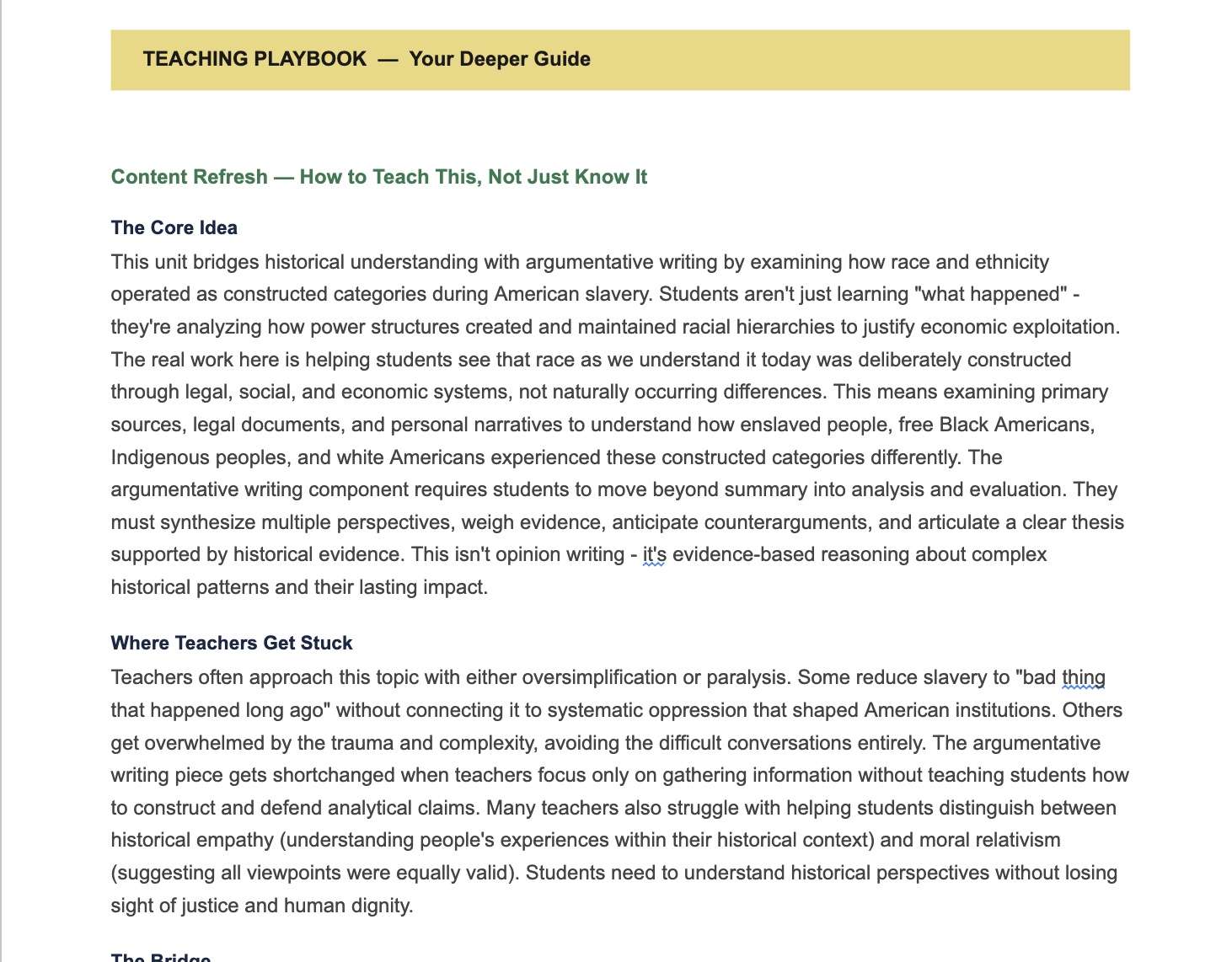
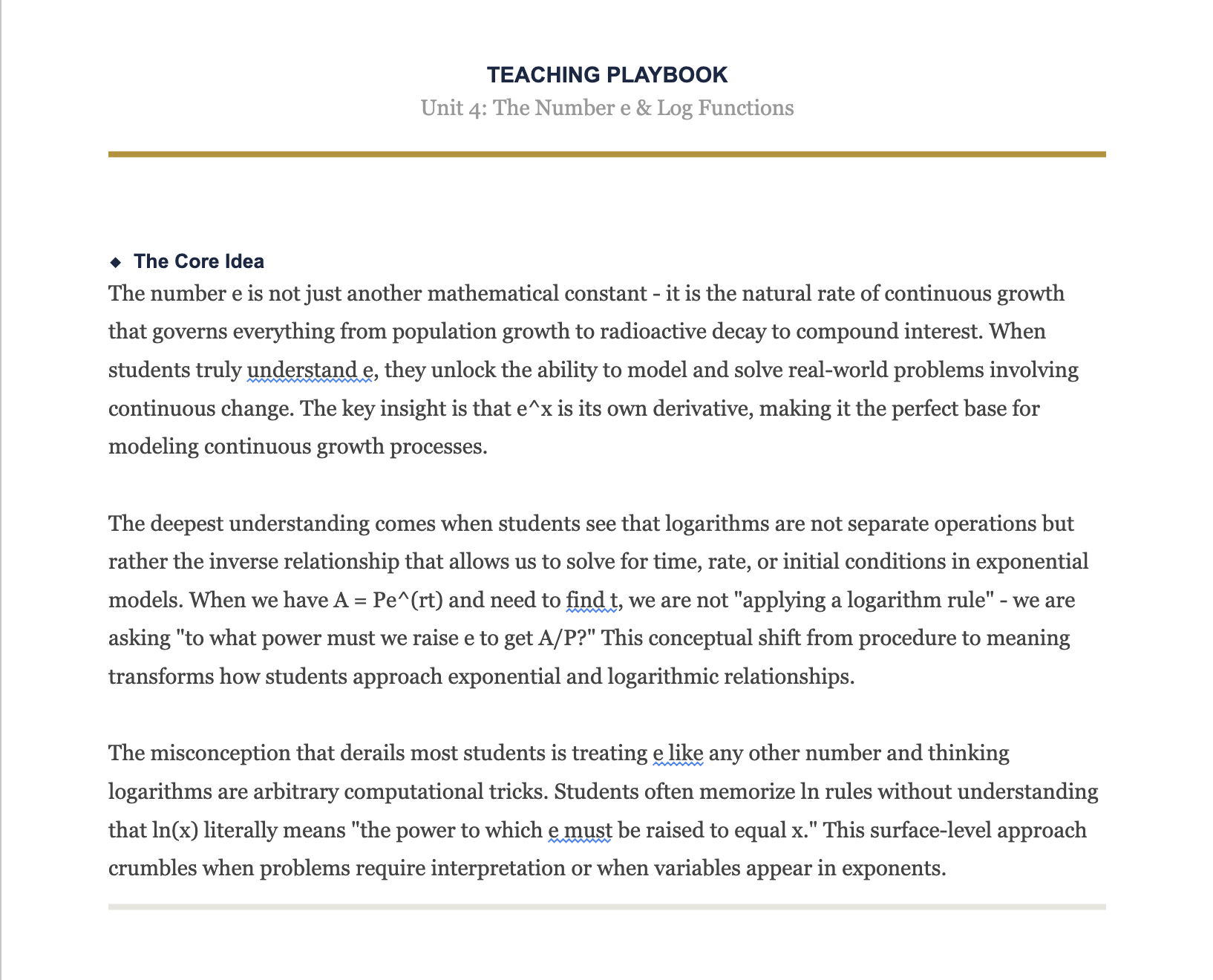
The preparation layer. A Teaching Playbook that gets a second-year teacher ready for the misconceptions a veteran already anticipates.
The thinking layer. A thought-partner that argues back, not a generator that complies.
“We've already adopted a curriculum.”
Good. That's the condition Nu Teacher works best under — not the objection to it.
Teachers can save their unit plan, scope and sequence, POI or MYP planner directly into Nu Teacher, and it becomes the north star: every recommendation placed inside your arc, not floating outside it. A school with a strong curriculum and Nu Teacher gets more out of both than a school with either alone. Where a curriculum is mandated, "we replace it" is dead on arrival. "We make it land in your building" is the only proposition worth having.
Built for the week your teachers are actually having.
Your curriculum as the north star
Teachers paste their unit plan, scope and sequence, POI or MYP planner into the class they teach. Nu Teacher reads it for the arc — what came before, what this builds toward, which standards are load-bearing — and plans inside it.
A thought-partner that talks back
Every lesson, brief, and practice set can be discussed in the app. Why is vocabulary placed after problem three? What happens if my students grab every number in problem five? Nu Teacher has read the whole document and answers from it — the teacher never copies their plan into another tool.
Planning help before the plan exists
“They bombed the quiz, I have ninety minutes Thursday, half of them are still shaky on factoring.” Nu Teacher helps a teacher think it through and names what to build — the moment before a lesson, which is where planning actually stalls.
Seven pathways, every subject
New lesson, quick practice, next in sequence, weekly plan, teaching brief, assessment design, scope and sequence. Math, ELA, science, social studies, arts, CTE, advisory — not a single-subject tool, and no second subscription to add one.
Assessment design
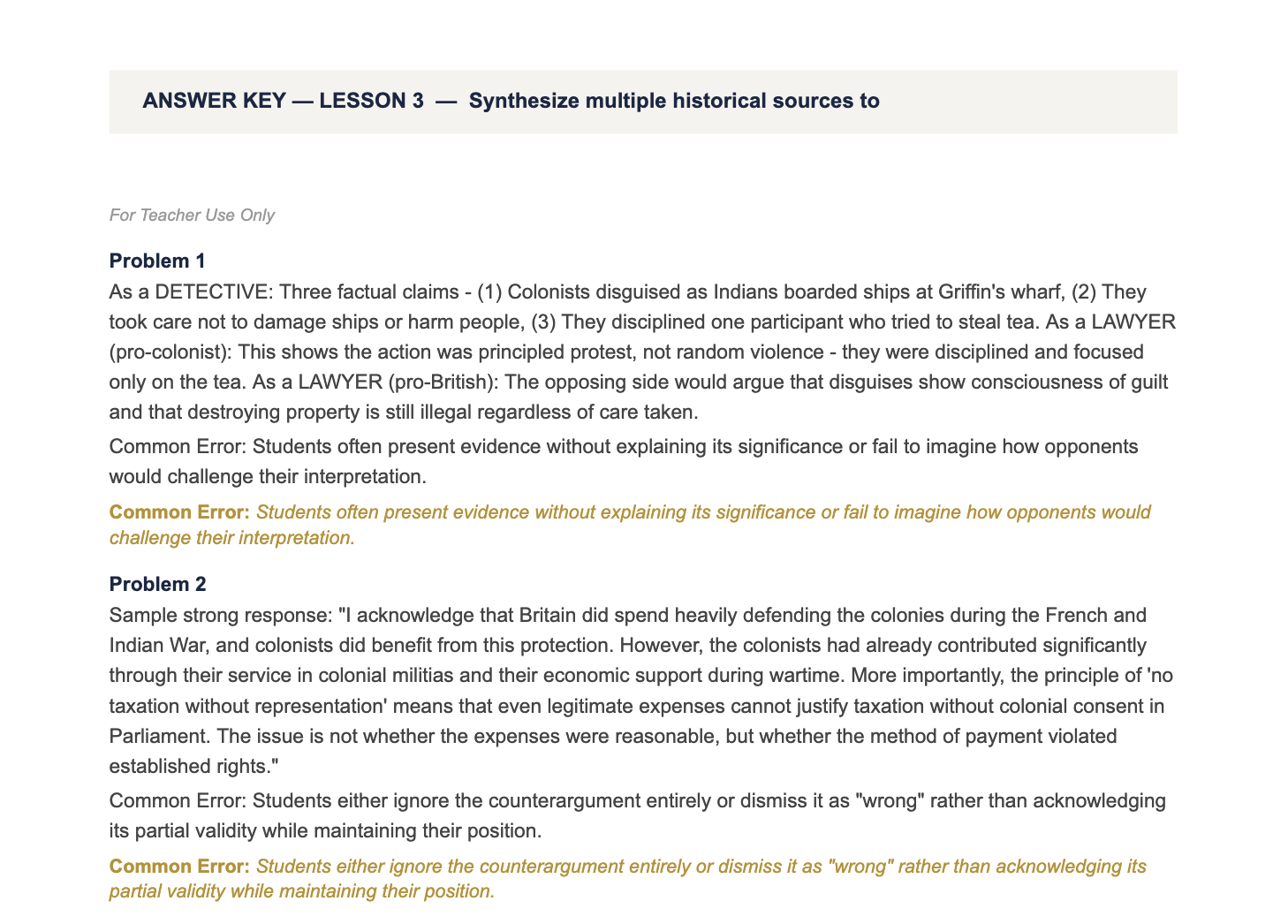
Multiple choice and extended response against your standards, with the answer key and the scoring guide. Built to the same pedagogy as the lessons: the wrong answers are the misconceptions the Teaching Playbook named, so a teacher reading the results learns which one a student is holding, not just that they missed it.
Scope and sequence
A full term mapped in one build — the arcs, what each one carries, where assessment lands. It also becomes that class's spine, so every lesson, weekly plan and assessment built afterward is placed inside the term rather than beside it. For a course a teacher is building from nothing, or a subject your adoption doesn't cover, this is the piece that was missing.
What we don't ask for.
Most of what makes AI hard to procure is the data it wants. Nu Teacher was designed to want as little as possible.
First names only — never last
Teachers enter first names, or what a student goes by, so problems read like they belong to that room. We do not ask for last names, student ID numbers, or anything drawn from a student record.
No IEPs, no 504 plans, ever
Teachers describe what a student needs in their own words — read-aloud, chunked text, processing time. Protected documents stay with the teacher, where the relationship and the legal obligation belong.
Counts, never content
Administrators see how many plans a teacher has built and when they were last active. Not lesson content, not chats, not what a teacher marked “needs reteach.” Teachers are told this plainly, in the app.
Teachers own their work
Plans a teacher builds belong to that teacher — the same way a document written in Google Classroom does. A school license buys access for staff, not ownership of what staff create.
What it costs, against what it replaces.
School leaders buy impact per dollar. So here is the arithmetic, with the assumptions showing — including the one we can't measure for you.
That works out to 49¢ to 82¢ per hour of planning work handled. The hours are an estimate, not a measurement — they're what the monthly allowance covers at full use, and what that work costs a teacher who builds it alone. A teacher who uses half the allowance gets half the hours and twice the per-hour cost, and that is still under two dollars.
One PD workshop
Per teacher. One day. What survives past the following Monday is whatever each teacher happened to write down.
Nu Teacher seat
Per teacher, full school year. The public price for the same access is $149 — your staff never pays above it, and larger licenses are quoted lower.
One substitute day
One teacher, one day, in New York City. A 15-seat license runs to fewer than seven of them.
What a seat carries
- 15 lessons a month
- 2 weekly plans a month
- 2 assessment designs a month
- Teaching briefs and quick practice — no monthly cap
- Scope and sequence, lesson-aware chat, every pathway
The same monthly allowance as the $149 individual plan, at $89 a seat — the discount is on the price, not on the product. A teacher who runs out mid-month can add a $5 Lesson Boost, or you can raise the seat count.
Funding. Schools have paid for Nu Teacher out of Title I Part A, PD, and instructional-materials budgets. Whether it's allowable under any particular grant is decided by your district and your state, not by us — it varies city to city, and your grants office makes the call. Tell us what documentation they need and we'll write it. Invoice and purchase order accepted on every license.
Watch real teachers
use it in real time.
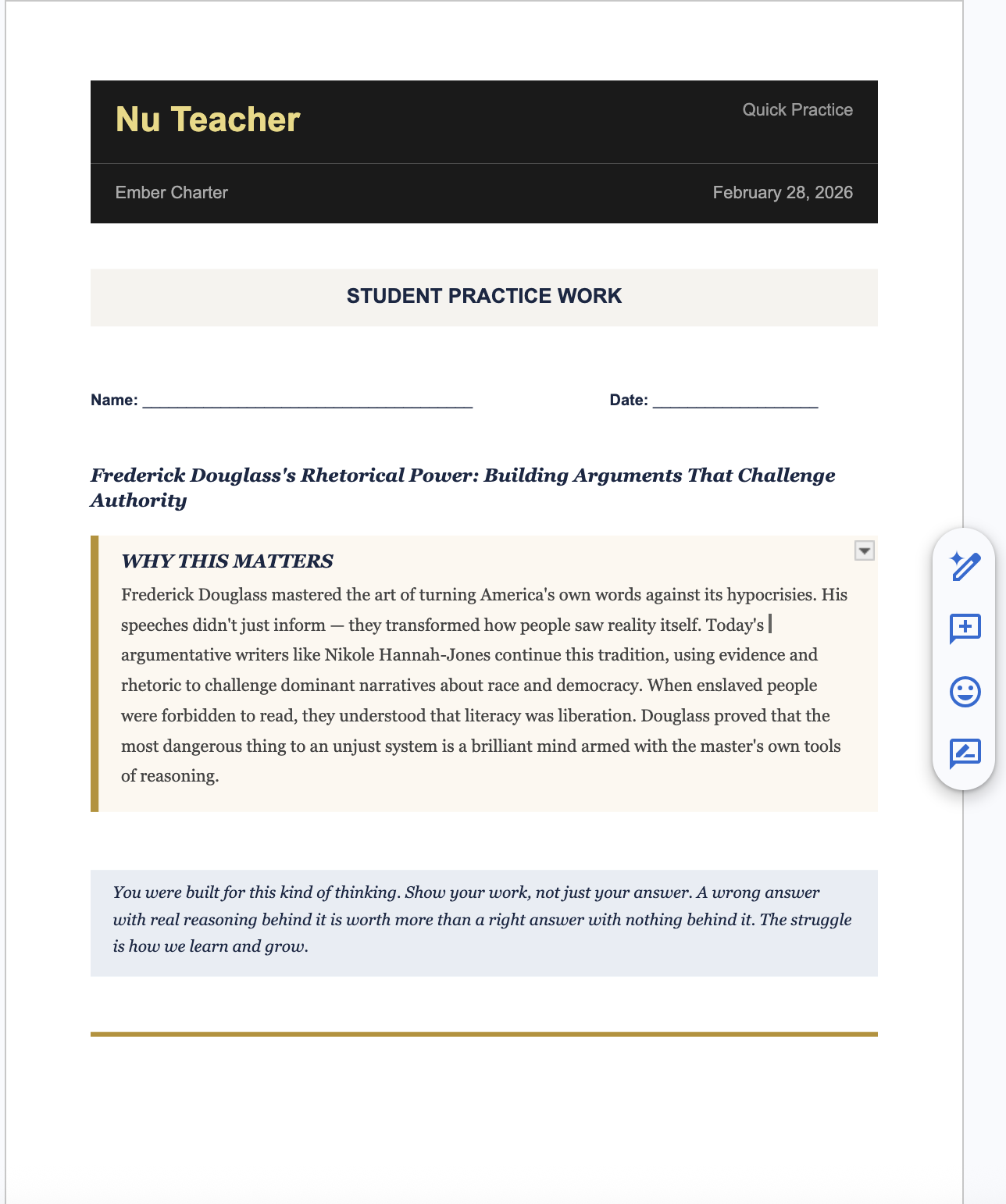
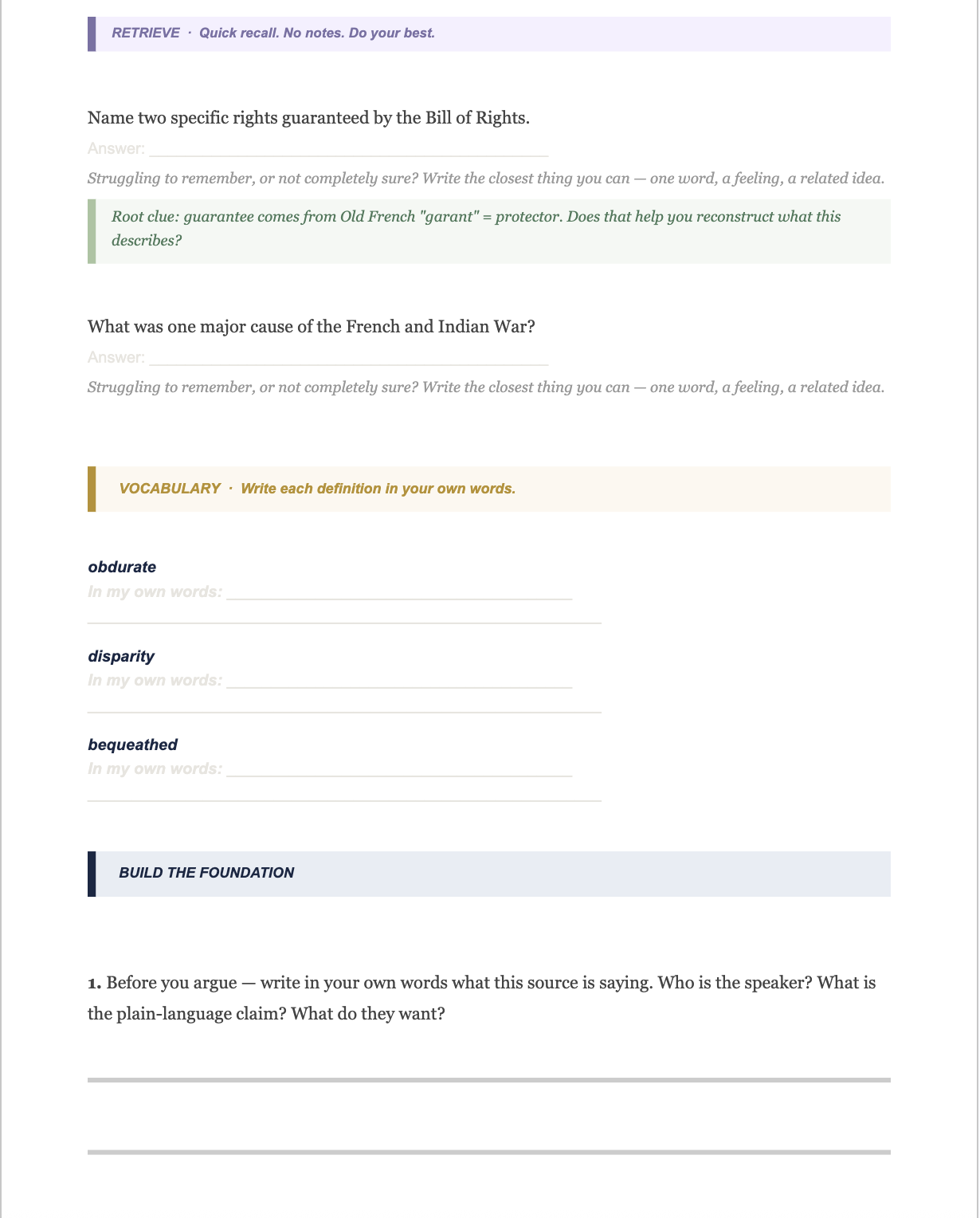
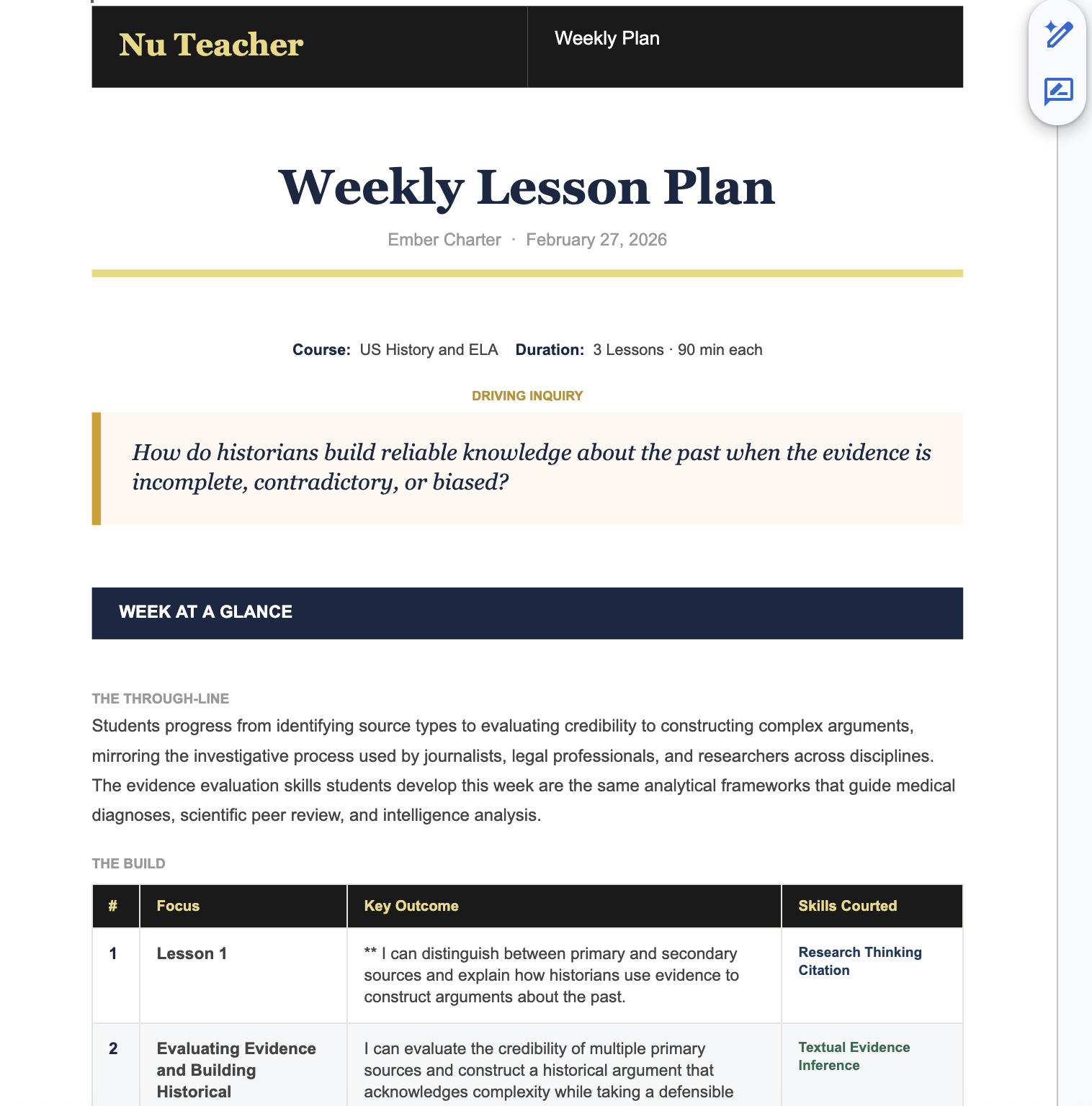
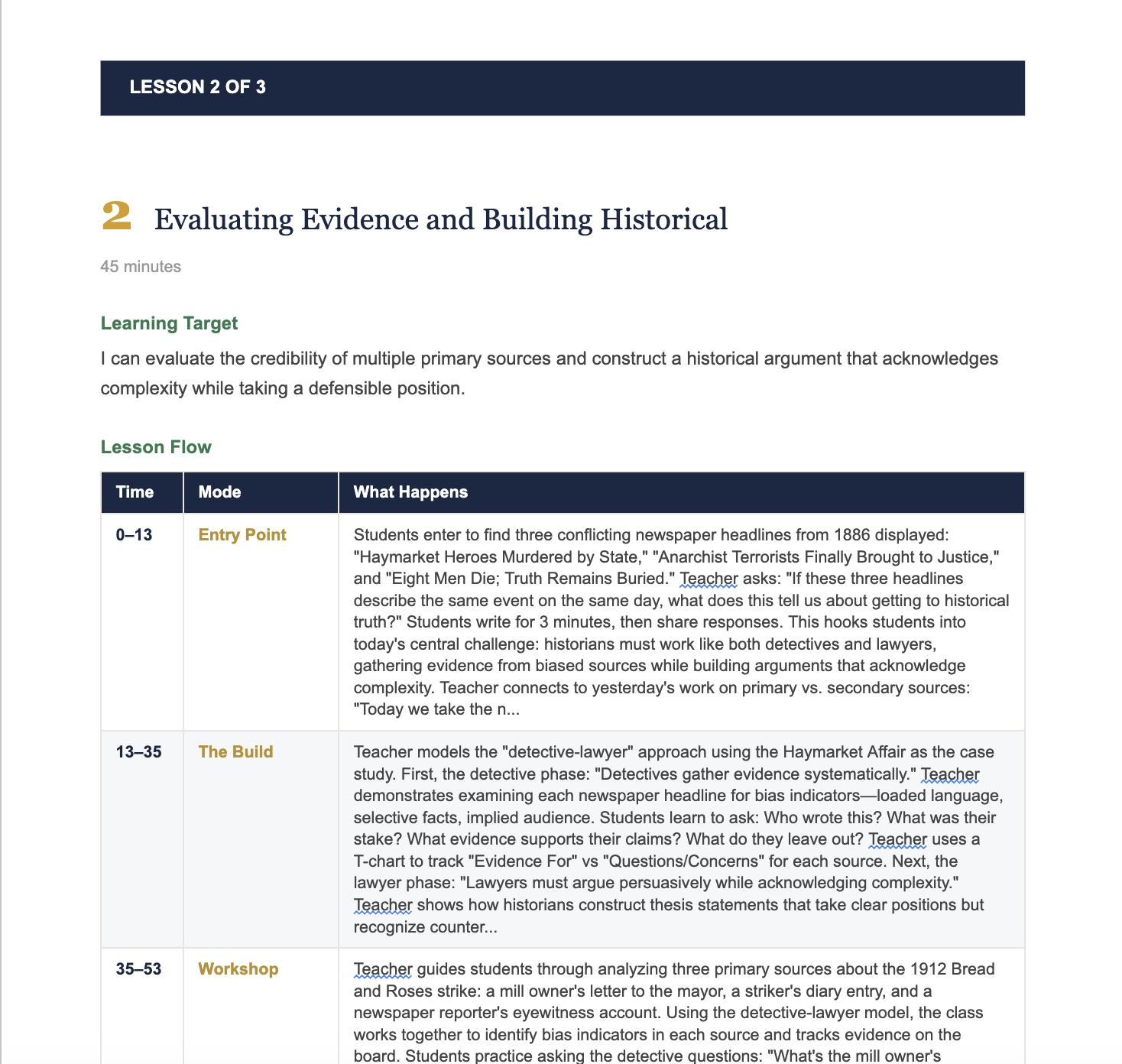
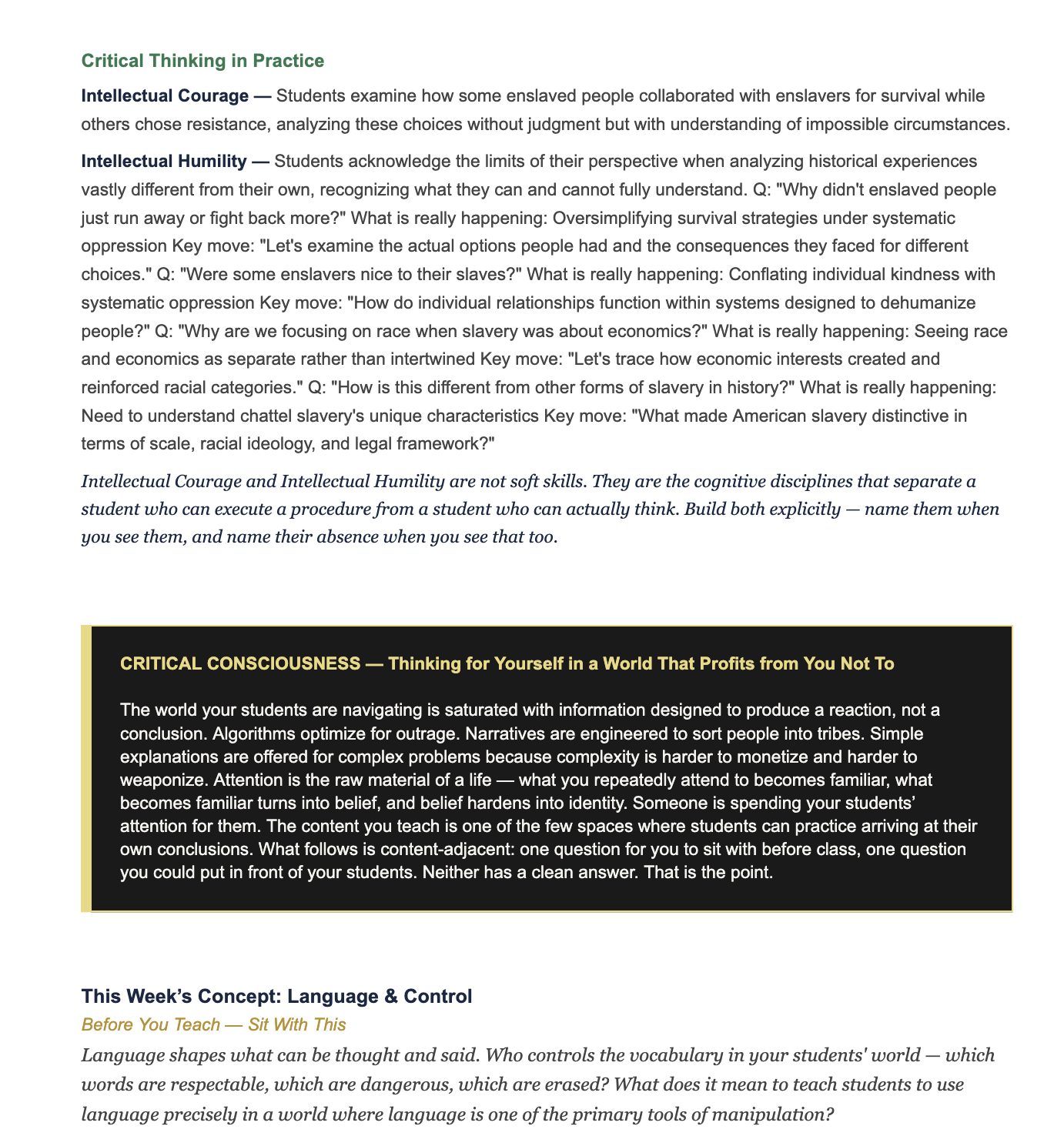
This is not a polished product demo. These are real teachers, in a real school, generating personalized lessons with their students' names woven throughout — in under three minutes.
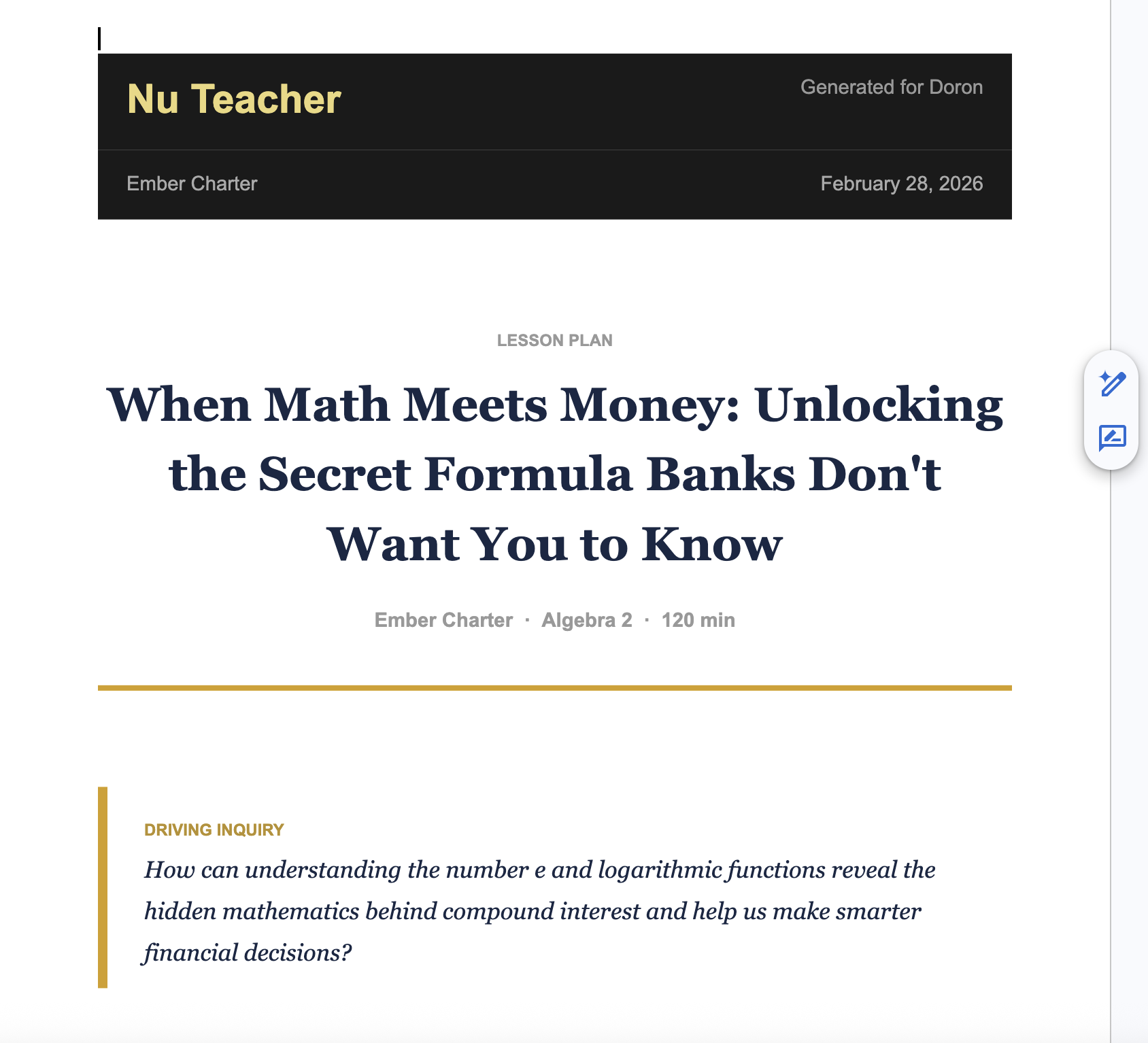
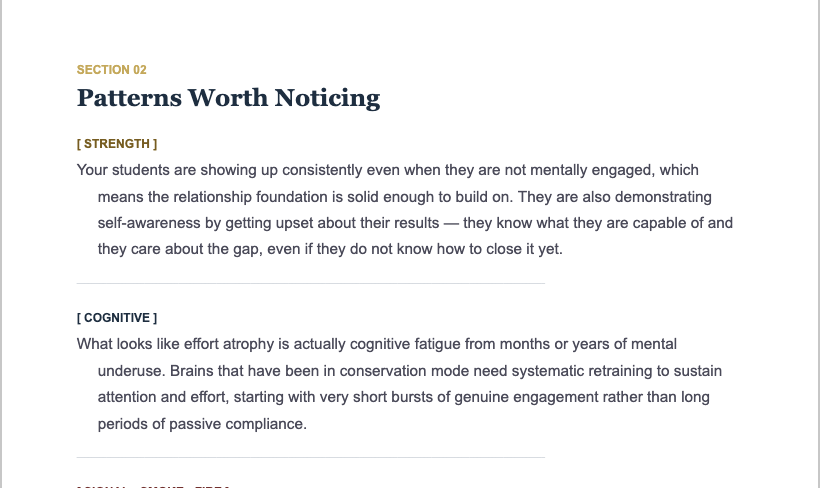
The Teaching Playbook, the tiered practice structure, the Beautiful Struggle framing — all there automatically. No extra prompting. No editing for cultural relevance. It comes out right the first time.
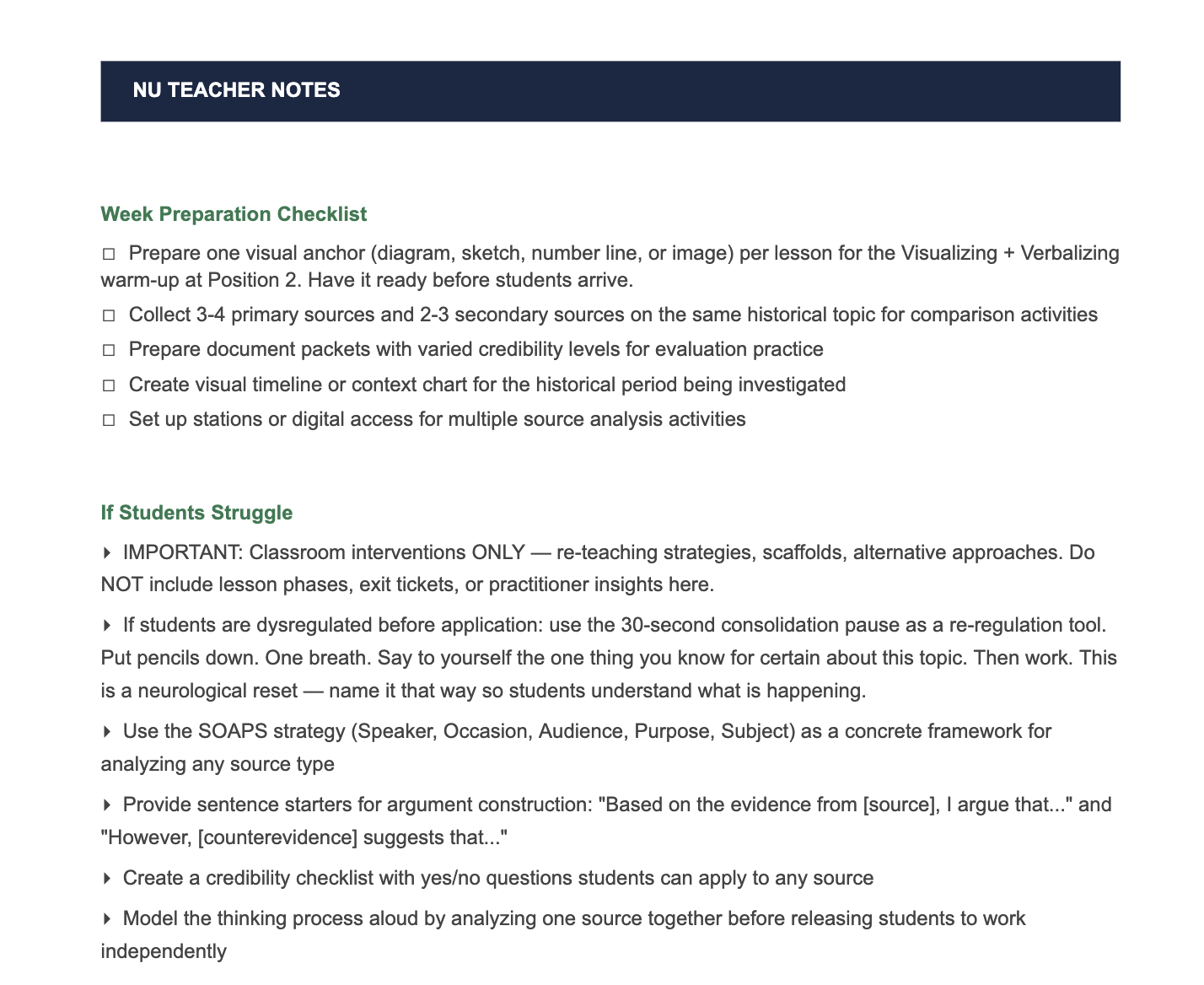
Your curriculum is the skeleton.
Nu Teacher is the tissue.
Whatever curriculum your school has adopted, it was written for every classroom — which means it wasn't written for any of them. Nu Teacher builds the layer a published curriculum structurally cannot: practice work in your students' names, a reteach for the six who didn't get Tuesday, cultural grounding for the room your teacher actually walks into. Not a replacement for your curriculum. The thing that makes it land.
What's inside every Nu Teacher plan
We don't replace what you've adopted.
We simply help it land better.
A published curriculum is written once, for everyone. It cannot know that third period has four newcomers, that your strongest reader stopped talking in November, or that the Tuesday lesson landed for eleven students and lost nine.
That gap isn't a flaw in your curriculum. It's the definition of one. Every teacher fills it — on Sunday nights, out of textbook copies and TPT downloads and whatever generic AI gives them. Nu Teacher fills it with the pedagogy you'd want them using.
What your curriculum does
Sets the scope and sequence. Establishes the standards arc. Provides the texts, the units, the assessments of record.
Guarantees coherence across grades and buildings. Survives teacher turnover. Anchors the year.
This is real, and Nu Teacher does not touch it.
What Nu Teacher adds
The adaptation layer. The same unit, rebuilt for the room it's actually being taught in — this week, these students, this teacher's read of what isn't landing.
The preparation layer. A Teaching Playbook that gets a second-year teacher ready for the misconceptions a veteran already anticipates.
The thinking layer. A thought-partner that argues back, not a generator that complies.
“We've already adopted a curriculum.”
Good. That's the condition Nu Teacher works best under — not the objection to it.
Teachers can save their unit plan, scope and sequence, POI or MYP planner directly into Nu Teacher, and it becomes the north star: every recommendation placed inside your arc, not floating outside it. A school with a strong curriculum and Nu Teacher gets more out of both than a school with either alone. Where a curriculum is mandated, "we replace it" is dead on arrival. "We make it land in your building" is the only proposition worth having.
Built for the week your teachers are actually having.
Your curriculum as the north star
Teachers paste their unit plan, scope and sequence, POI or MYP planner into the class they teach. Nu Teacher reads it for the arc — what came before, what this builds toward, which standards are load-bearing — and plans inside it.
A thought-partner that talks back
Every lesson, brief, and practice set can be discussed in the app. Why is vocabulary placed after problem three? What happens if my students grab every number in problem five? Nu Teacher has read the whole document and answers from it — the teacher never copies their plan into another tool.
Planning help before the plan exists
“They bombed the quiz, I have ninety minutes Thursday, half of them are still shaky on factoring.” Nu Teacher helps a teacher think it through and names what to build — the moment before a lesson, which is where planning actually stalls.
Seven pathways, every subject
New lesson, quick practice, next in sequence, weekly plan, teaching brief, assessment design, scope and sequence. Math, ELA, science, social studies, arts, CTE, advisory — not a single-subject tool, and no second subscription to add one.
Assessment design
Multiple choice and extended response against your standards, with the answer key and the scoring guide. Built to the same pedagogy as the lessons: the wrong answers are the misconceptions the Teaching Playbook named, so a teacher reading the results learns which one a student is holding, not just that they missed it.
Scope and sequence
A full term mapped in one build — the arcs, what each one carries, where assessment lands. It also becomes that class's spine, so every lesson, weekly plan and assessment built afterward is placed inside the term rather than beside it. For a course a teacher is building from nothing, or a subject your adoption doesn't cover, this is the piece that was missing.
What we don't ask for.
Most of what makes AI hard to procure is the data it wants. Nu Teacher was designed to want as little as possible.
First names only — never last
Teachers enter first names, or what a student goes by, so problems read like they belong to that room. We do not ask for last names, student ID numbers, or anything drawn from a student record.
No IEPs, no 504 plans, ever
Teachers describe what a student needs in their own words — read-aloud, chunked text, processing time. Protected documents stay with the teacher, where the relationship and the legal obligation belong.
Counts, never content
Administrators see how many plans a teacher has built and when they were last active. Not lesson content, not chats, not what a teacher marked “needs reteach.” Teachers are told this plainly, in the app.
Teachers own their work
Plans a teacher builds belong to that teacher — the same way a document written in Google Classroom does. A school license buys access for staff, not ownership of what staff create.
What it costs, against what it replaces.
School leaders buy impact per dollar. So here is the arithmetic, with the assumptions showing — including the one we can't measure for you.
That works out to 49¢ to 82¢ per hour of planning work handled. The hours are an estimate, not a measurement — they're what the monthly allowance covers at full use, and what that work costs a teacher who builds it alone. A teacher who uses half the allowance gets half the hours and twice the per-hour cost, and that is still under two dollars.
One PD workshop
Per teacher. One day. What survives past the following Monday is whatever each teacher happened to write down.
Nu Teacher seat
Per teacher, full school year. The public price for the same access is $149 — your staff never pays above it, and larger licenses are quoted lower.
One substitute day
One teacher, one day, in New York City. A 15-seat license runs to fewer than seven of them.
What a seat carries
- 15 lessons a month
- 2 weekly plans a month
- 2 assessment designs a month
- Teaching briefs and quick practice — no monthly cap
- Scope and sequence, lesson-aware chat, every pathway
The same monthly allowance as the $149 individual plan, at $89 a seat — the discount is on the price, not on the product. A teacher who runs out mid-month can add a $5 Lesson Boost, or you can raise the seat count.
Funding. Schools have paid for Nu Teacher out of Title I Part A, PD, and instructional-materials budgets. Whether it's allowable under any particular grant is decided by your district and your state, not by us — it varies city to city, and your grants office makes the call. Tell us what documentation they need and we'll write it. Invoice and purchase order accepted on every license.
Watch real teachers
use it in real time.
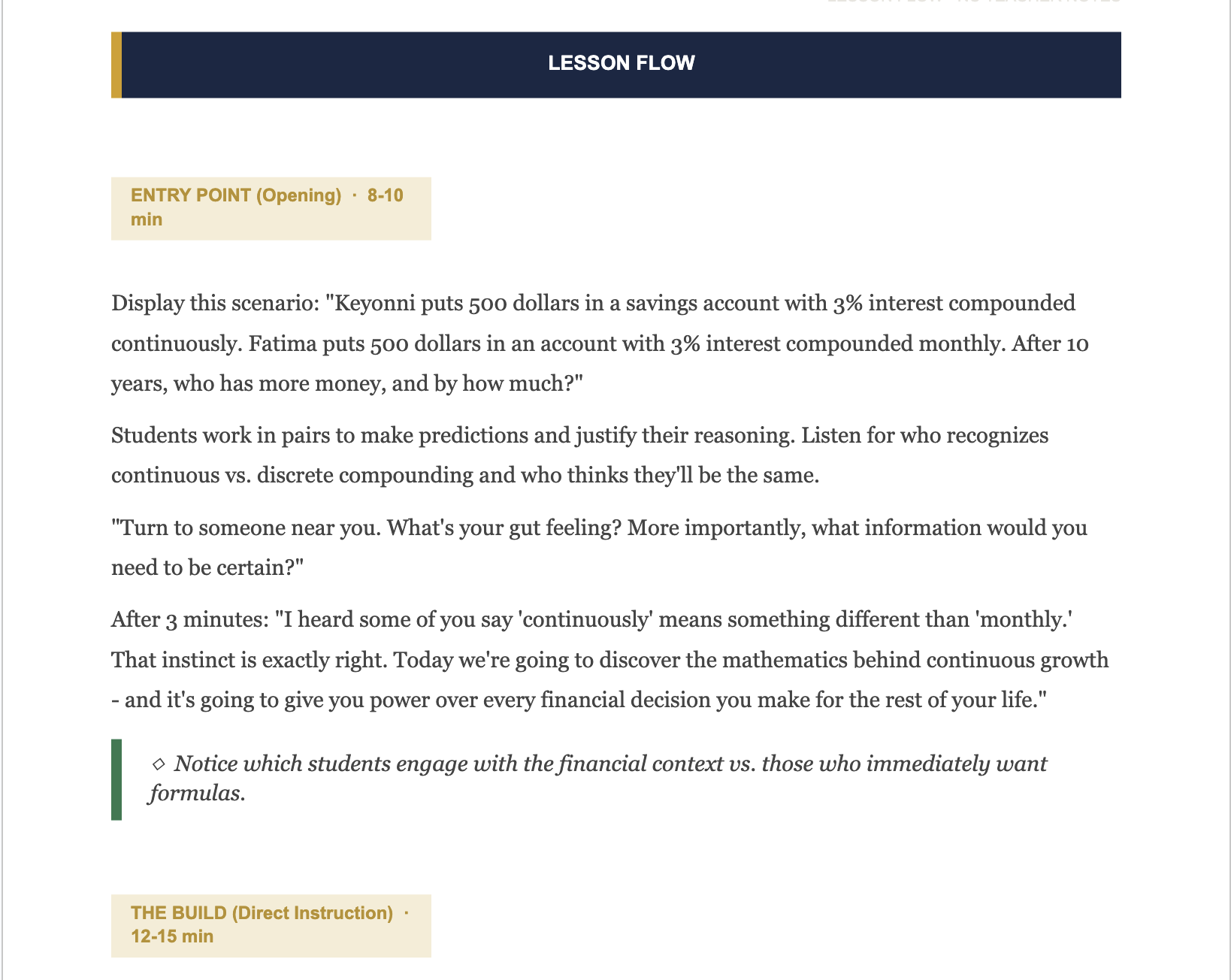
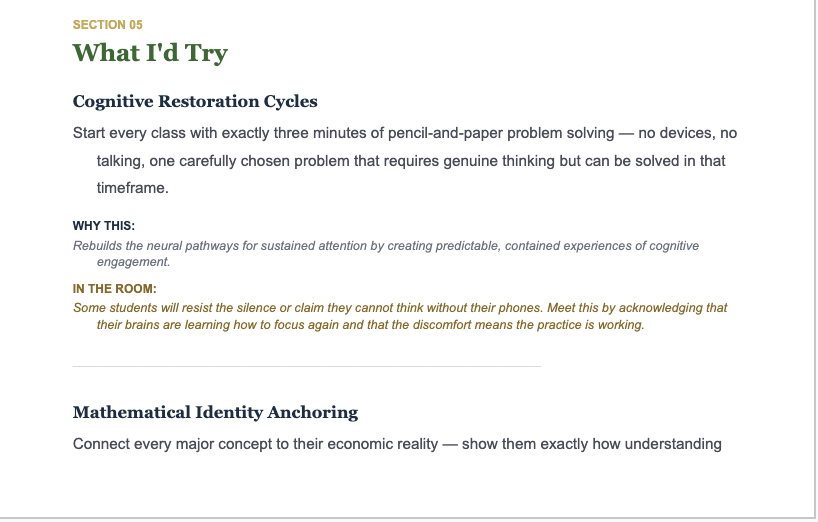
This is not a polished product demo. These are real teachers, in a real school, generating personalized lessons with their students' names woven throughout — in under three minutes.
The Teaching Playbook, the tiered practice structure, the Beautiful Struggle framing — all there automatically. No extra prompting. No editing for cultural relevance. It comes out right the first time.
Put it in front of one grade team.
A pilot is a real team using it on real weeks — their units, their students, their Sunday nights. Not a demo account and not a sandbox. What you learn in three weeks of that is worth more than anything I could show you on a call.
No card, no procurement, nothing to cancel. If it doesn't earn the line item, that's an answer too, and you'll have it before you've spent anything.
01 You tell me who
The form below — a few questions about your building, your team and your timeline. Two minutes.
02 We talk
I reply personally within two business days and we find twenty minutes. If you're in the New York area, I'd rather come to you.
03 Your team plans
Seats go live for the teachers you name. You see their actual lessons, not a case study about someone else's.
Consultants and networks: the same conversation, at a different scale. Multi-site licenses and partner terms are quoted — say so in the last field and I'll bring numbers to the call.